Certifying LLM Judges
Tight PAC-Bayes Generalisation Guarantees for Large Language Model Judges
Introduction
Large language model (LLM) judges are increasingly used to monitor the outputs of LLM-based AI agents. Guardrail models such as Llama Guard
This motivates our central question: can we obtain practical, non-vacuous guarantees for safety judges using simple, standard adaptation pipelines and the same data for both training and certification?
Our contributions are the following:
- We formalise PAC-Bayes certification for judges evaluating prompt–response pairs drawn from a fixed deployed generator, and certify both 0–1 classification risk and Brier risk, to obtain certificates for both predictive accuracy and calibration.
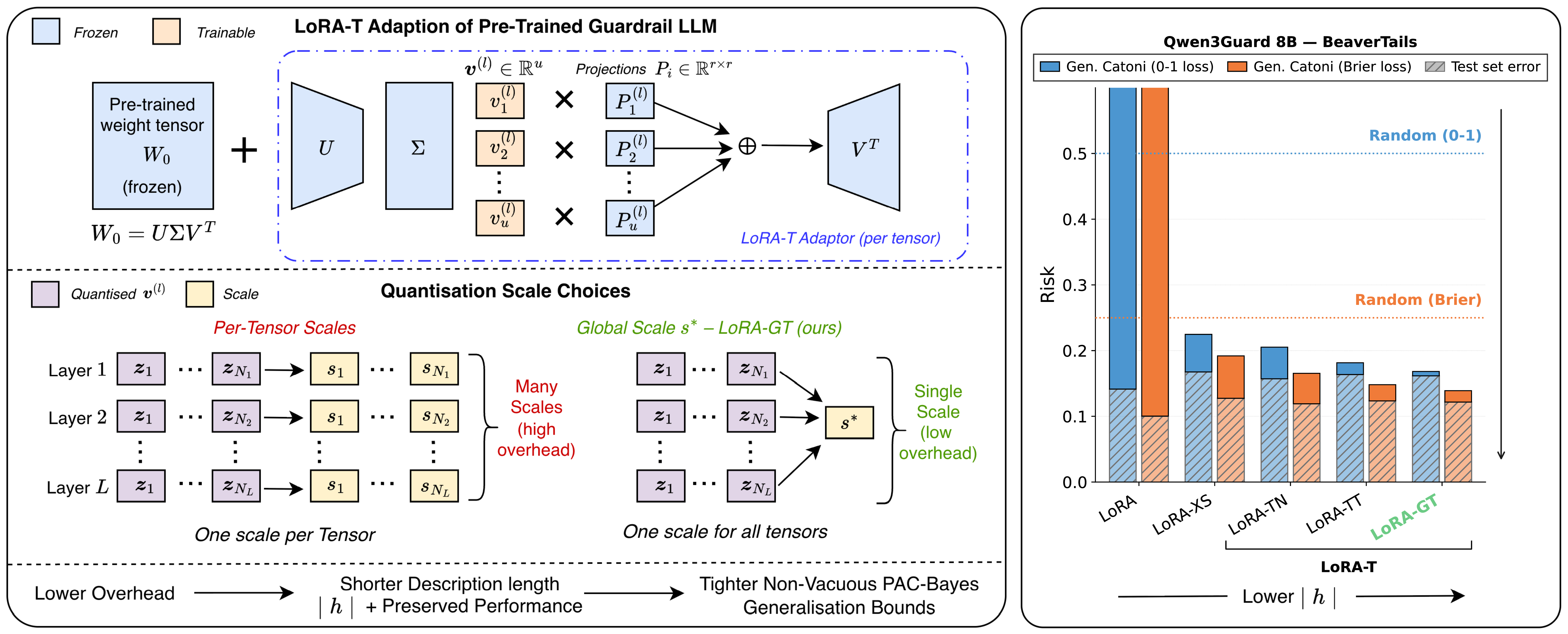
- We introduce LoRA-GT, which shares a single quantisation scale across layers and yields the tightest certificates in all 40 model–dataset–loss cases.
- Across five guardrail models and four benchmarks, we show that certificate tightness depends more on adaptation complexity than on base model scale.
Why Certify Safety Judges?
For safety decisions to be reliable, judges must generalise beyond their evaluation samples, while thresholded safety decisions additionally require well-calibrated uncertainty estimates. Validation-based bounds can provide guarantees for a fixed predictor using data held out from training, but can be costly when labelled safety data are limited, and depend only on held-out performance and sample size. They therefore provide little insight into which properties of the learned model and learning process are associated with strong generalisation.
Guardrail models are already capable safety judges, so adaptation to a new safety taxonomy or set of guidelines can be viewed as a simple refinement of their existing safety capabilities. PAC-Bayes theory
PAC-Bayes Certificates for Judges
Let a fixed generator \(G\) produce responses \(y\) to prompts \(x \sim \mathbb{P}_{\mathcal{D}}\), inducing a joint distribution \(\mathbb{P}_{\mathcal{D},G}\) over prompt–response pairs. A judge \(h\) tries to emulate a ground-truth safety label \(z^*(x,y) \in \{0,1\}\). We certify the judge’s risk on the deployment distribution,
\[\mathcal{R}_G(h) = \mathbb{E}_{(x,y)\sim\mathbb{P}_{\mathcal{D},G}}\big[\ell(h(x,y), z^*(x,y))\big],\]from \(n\) i.i.d. labelled pairs. Here fixed refers to the fact that the generator weights, decoding procedure, system prompt, and prompt distribution remain unchanged between certification and deployment.
Compression-Based Bounds
Following prior compression-based analyses of LLMs
- a generalised Catoni bound
, whose infimum over \(\lambda\) holds on a single high-probability event, so no union bound or held-out data is needed; - Elias \(\delta\) coding, which is tighter than the Elias \(\gamma\) code used in prior work;
- Brotli compression of the quantised adaptor, which shortens its description further.
The Oversight Model Certificate
With a point-mass posterior on the deployed judge, the KL term reduces to the description length (plus a small coding overhead \(\mathrm{KL}^{\mathrm{UB}}\)). With probability at least \(1-\beta\), for all judges \(h\) simultaneously,
\[\mathcal{R}_{G}(h) \leq \inf_{\lambda>0} \left\{ \frac{1}{1 - e^{-\lambda/n}} \left[ 1 - \exp\left(-\frac{\lambda \widehat{\mathcal{R}}_S(h) + \mathrm{KL}^{\mathrm{UB}}(h) + \log \frac{2+\sqrt{2n}}{\beta}}{n} \right) \right] \right\}.\]The certificate applies directly to the single deployed judge, so no Gibbs sampling is needed. It makes no assumptions about the learning algorithm. The adaptor is trained conventionally and certified post hoc on the same data.
LoRA-GT: Global-Scale Quantised Adaptations
The complexity term is governed by adaptor description length. Increasingly compact parameter-efficient adaptations, from LoRA
The scale overhead. Under aggressive quantisation, the per-layer bfloat16 scales dominate the description length. At \(u{=}1\), \(b{=}2\) on Llama-Guard-3-8B, the weights require only 64 bits while the scales require 512. LoRA-GT shares a single global scale across layers, cutting the total from 576 to 80 bits, an 86% reduction. The scale is chosen by a fixed search over representable bfloat16 values, starting from the smallest clipping-free scale.
Empirical Evaluation
We evaluate five guardrail models: Llama Guard 3 (1B, 8B) and Qwen3Guard (0.6B, 4B, 8B). We use four benchmarks: Egida (\(n{=}792\)), OpenAI Moderation (\(n{=}1{,}344\)), Aegis (\(n{=}28{,}984\)) and BeaverTails (\(n{=}300{,}567\)). Each adaptor is trained with standard supervised fine-tuning, then quantised and compressed for certification.
Non-Vacuous and Tight Guarantees
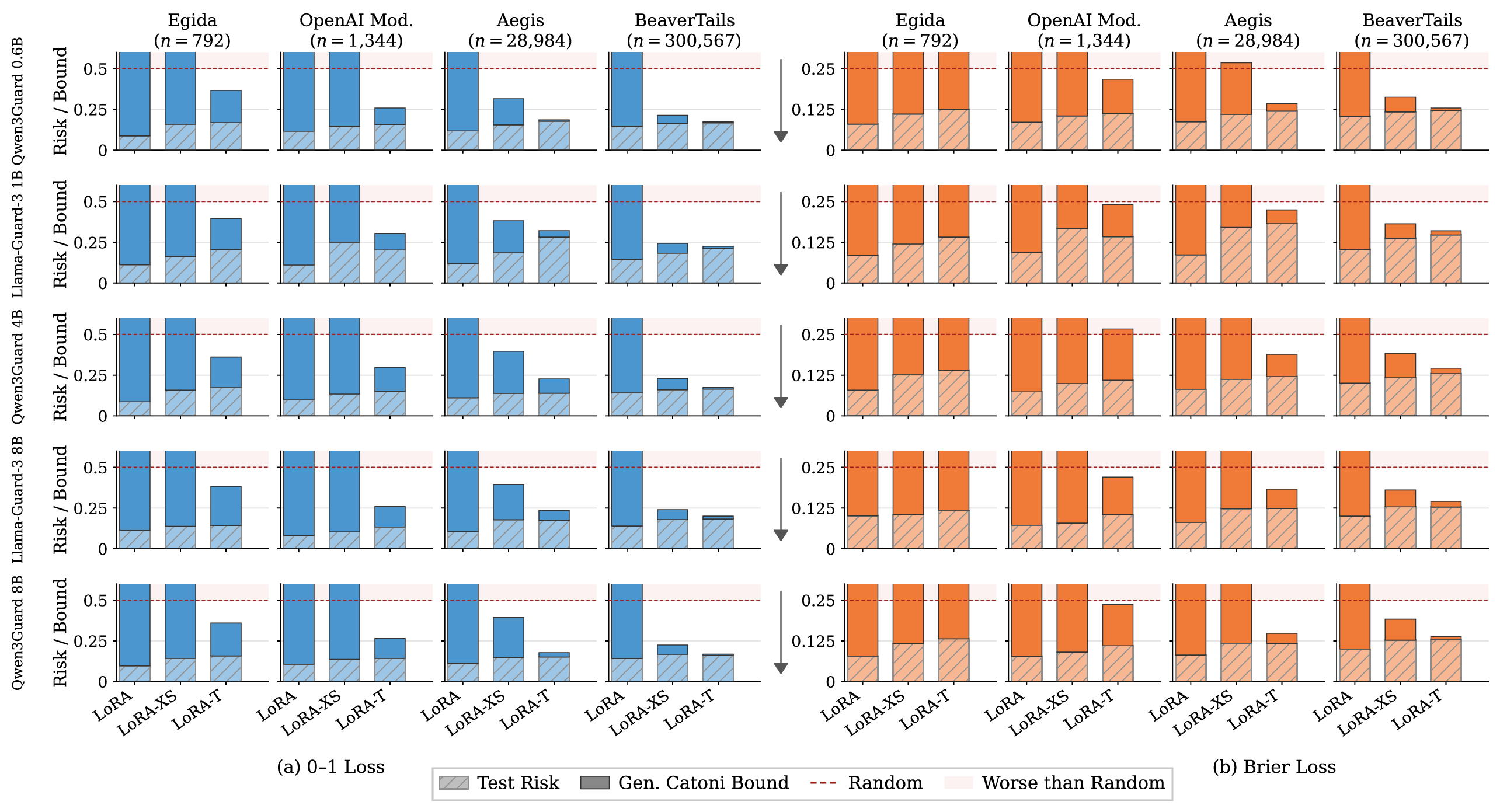
We obtain non-vacuous guarantees under both losses across models, datasets and adaptor families. This holds even on Egida and OpenAI Moderation, which have only 792 and 1,344 certification samples. Standard LoRA is vacuous in every case, even on BeaverTails with \(n \approx 300\)k: the complexity term depends on \(\lvert h \rvert / n\), and LoRA descriptions there take 0.8M to 28M bits.
Compression Yields the Tightest Guarantees
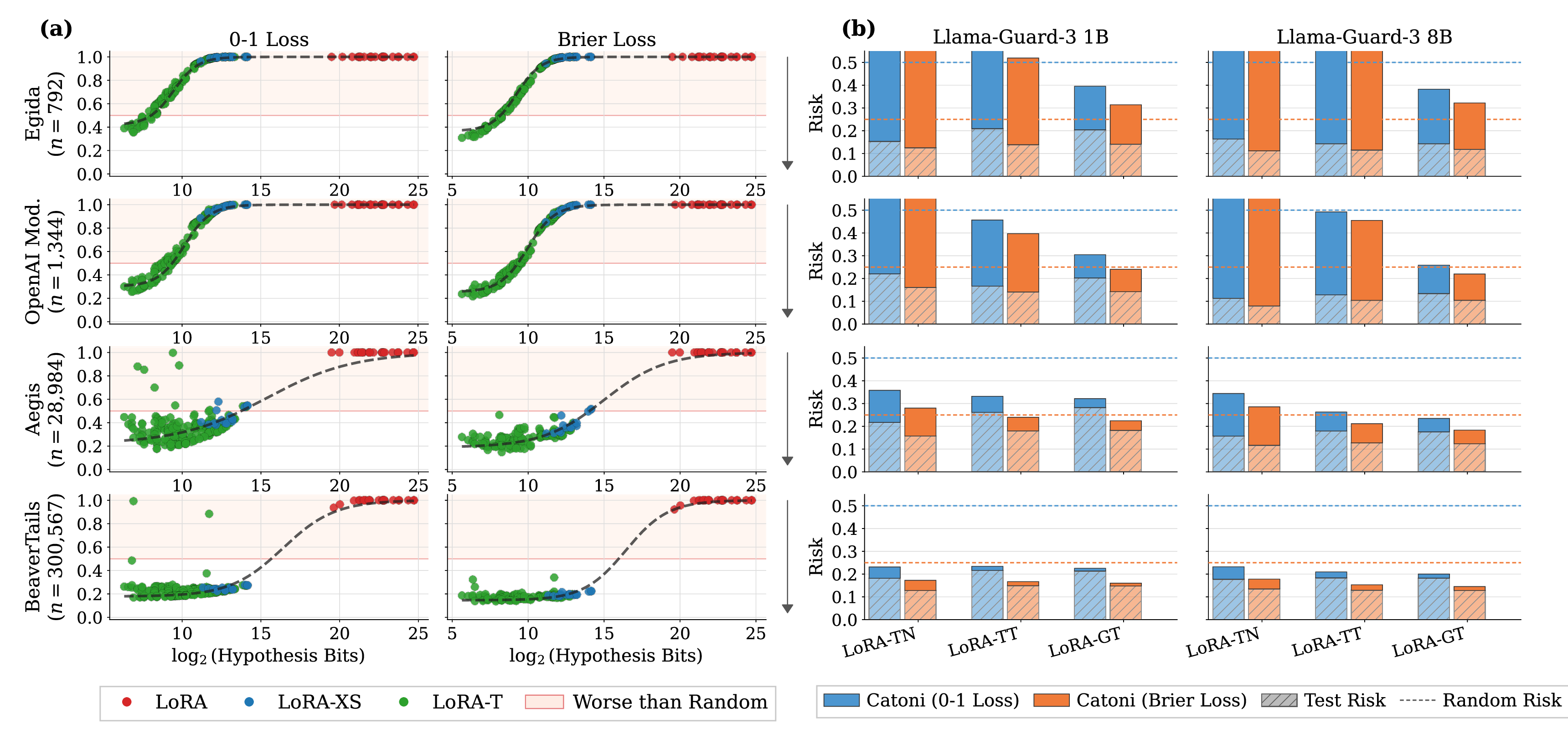
Certificate tightness closely tracks adaptor description length. The description-length ordering is LoRA, LoRA-XS, LoRA-TN, LoRA-TT, then LoRA-GT. It matches the certificate ordering in 39 of 40 cases, despite large differences in backbone scale. On BeaverTails, quantised LoRA-GT has 2.1 to 6.7 points higher test risk than LoRA, while its certificate falls from 1.000 to between 0.169 and 0.226.
How Far Compression Can Go
Quantisation shortens descriptions but can also change the judge’s predictions. We measure this as functional distortion, the change in risk caused by quantisation:
\[\Delta_G(h,\tilde h) = \mathbb{E}_{(x,y)\sim\mathbb{P}_{\mathcal{D},G}}\big[\ell(\tilde h(x,y),z^*) - \ell(h(x,y),z^*)\big].\]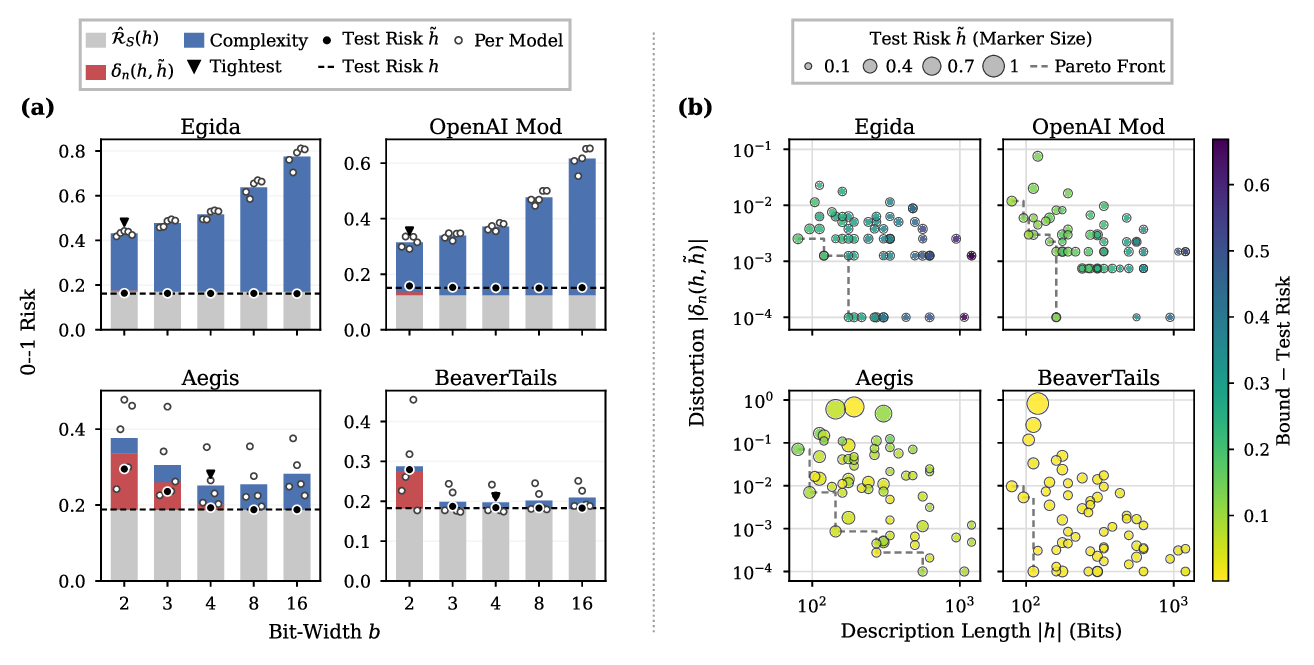
On the smaller benchmarks, 2-bit quantisation gives the tightest certificates. On Aegis and BeaverTails, the complexity savings are already small relative to \(n\), so the extra distortion at 2 bits loosens the certificate and 4 bits wins.
Takeaways
- Compact safety adaptations yield non-vacuous, often tight guarantees for both classification and Brier risk, even with only 792 certification samples and no held-out validation set.
- Adaptation complexity matters more than backbone scale. Adaptor description length tracks certificate tightness more closely than model size, and LoRA-GT is tightest in all 40 cases.
- Aggressive quantisation helps most when data are scarce. With more data, quantisation error can outweigh the smaller complexity savings.
Code and Paper
- Paper: OpenReview
- Code: GitHub
@inproceedings{lamb2026tight,
  title     = {Tight {PAC}-{Bayes} Generalisation Guarantees for Large Language Model Judges},
  author    = {Lamb, Tom A and Torr, Philip H S and Rudner, Tim G J},
  booktitle = {Advances in Neural Information Processing Systems},
  year      = {2026}
}